What is Your Worldview?
Why Your Heart Orientation Matters

18 hours ago
This is illustrated in the contrasting life-journeys of King Solomon and his father, King David.
As you read, ask yourself: Is my life-journey more like Solomon’s or David’s?
Solomon’s downward slide from God
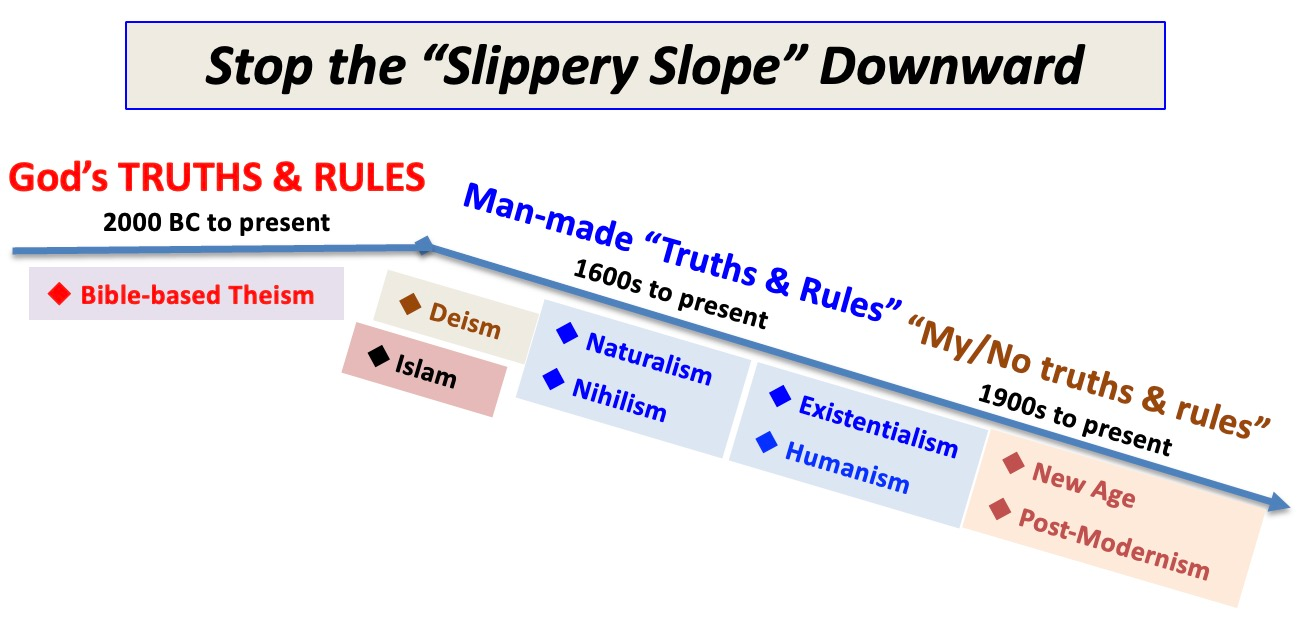
King Solomon’s wisdom didn’t prevent him from sliding down the “Slippery Slope” from God’s absolute TRUTHS and RULES. Solomon was unaware of this descent from Biblical Theism to embrace other worldviews.
1st. Solomon initially had a personal relationship with God (Prime Reality), who blessed him with Godly wisdom for living in External Reality and for writing over 1,000 Proverbs that proclaimed God’s TRUTHS and RULES. Solomon believed in the God of Biblical Theism, more with his wise mind than with a whole heart for God like his father David experienced.
2nd. Solomon began to rely on his own earthly wisdom as he became more self-sufficient and self-reliant. His mind revered/feared God less and less, and he pondered everything under the sun by engaging in free thinking. His personal relationship with God became impersonal and distant. Unaware, Deism replaced Biblical Theism as his worldview.
3rd. Solomon disobeyed God’s commands, by marrying foreign women and promoting worship of their gods. More and more he did-his-own-thing in the natural realm (“under the sun”), such as accumulating unmatched wealth and prestige. Unaware, Solomon embraced Naturalism/Humanism and promoted this throughout his earthy kingdom.
4th. Solomon ultimately experienced life as totally meaningless and void. His wished he had never been born, as he descended into Nihilism.
“When I surveyed all that my hands had done and what I had toiled to achieve, everything was meaningless, a chasing after the wind; nothing was gained under the sun” (Ecclesiastes 2:11 TNIV).
5th. Towards the end of his life, Solomon proclaimed:
“Here now is my final conclusion: Fear God and obey his commands, for this is everyone’s duty. God will judge us for everything we do, including every secret thing, whether good or bad.
For God will bring every deed into judgment, including every hidden thing, whether it is good or evil” (Ecclesiastes 12:13–14 NASB).
Solomon’s life illustrates the downward slide from Biblical Theism to other worldviews.
Despite great wisdom, Solomon did not heed his own Proverb:
“The wisdom of the prudent is to give thought to their ways,
but the folly of fools is deception” (Proverbs 14:8 NIV).
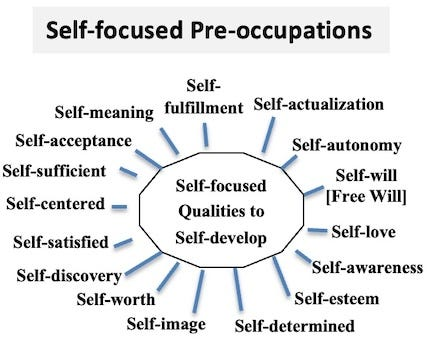
Instead, he became Self-focused, exalting himself and his self-sufficiency, and pursued other Self-focused pre-occupations. Until this became vain and meaningless.
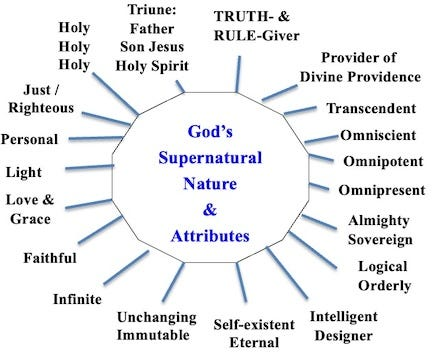
In contrast to Solomon, David focused on God’s Presence (supernatural nature and attributes) throughout his life, and on God’s Providence in the good and bad times. He described this in over 70 Psalms that he wrote.
David’s Psalms have inspired millions to know the God that David knew so personally. Millions recite David’s Psalms to praise God for the good times and to request God’s Presence and Providence during the bad times.
King David’s heart for God
David, the little shepherd boy, was chosen to be King of Israel because he had a “heart for God.” This is evident in the many Psalms he wrote (about half of the 150 Psalms).
Towards the end of his life, David reflected back in hindsight and summarized his life-journey — and revealed his heart for God — in the beloved 23rd Psalm.
In verses 1–3, David praises God for what He has done during the good times. This description lets us know about God like David knew.
“The Lord is my shepherd; I shall not want.
He makes me to lie down in green pastures;
He leads me beside the still waters.
He restores my soul;
He leads me in the paths of righteousness for His name’s sake.”
David also experienced many bad times: Saul chased him and tried to kill David for eight years; David committed adultery with Bathsheba and had her husband Uriah murdered (and finally repented; see Psalm 51); David grieved deeply as his first son was dying; his older sons tried to kill him and take over the kingship of Israel; David assembled the building materials to build The Temple to honor God, but God wouldn’t let him build it.
In versus 4–6, David talks person-to-person with God (as You), revealing how intimately he knows God is with him during the bad times. [I can’t count the number of times I recited verse 4 when going through a valley.]
Notice how David intimately knows God’s Omnipresence, Omnipotence and Omniscience because You are with me: [emphasis mine]
“Yea, though I walk through the valley of the shadow of death,
I will fear no evil; for You are with me; [God’s Omnipresence]
Your rod and Your staff, they comfort me.
You prepare a table before me in the presence of my enemies;
You anoint my head with oil; My cup runs over. [God’s Omnipotence]
Surely goodness and mercy shall follow me all the days of my life;
And I will dwell in the house of the Lord forever.” [God’s Omniscience]
Takeaway questions to answer
· Has your life-journey been more like Solomon’s or David’s? Why?
· Do you want a more whole-hearted orientation towards God?
· Do you praise God for His Presence and Providence during the good times? During the bad times?
· Has a transition from good times to bad times caused an inner transformation so you know God intimately?
Do you want to Stop the “Slippery Slope” downward?
If you’re interested in this, please contact me (billgray@god-nods.com) to learn more about my 6-part series of Worldview Training Manuals. Each provides “head knowledge” that you convert into “practical know-how” competencies.
Manuals 1–3 focus on Apologetics — HOW to defend your Christian faith and Biblical worldview, by explaining what you know and believe.
Leave a Reply